
Ghana Vs England at the 2026...
June 24, 2026

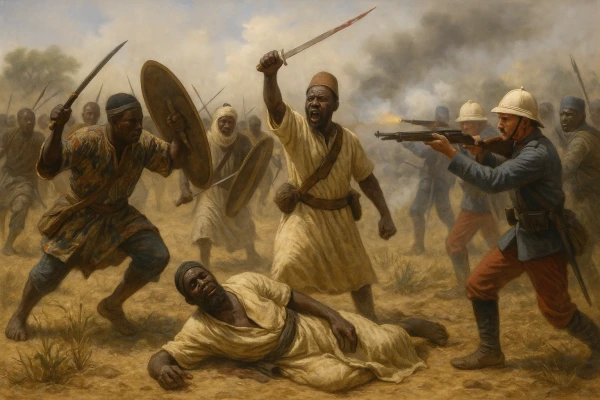
The Battle of Kanjaga is remembered as one of the dramatic turning points in the turbulent power struggles of late nineteenth-century West Africa.
Fought on 14 March 1897, the clash pitted the feared warlord Babatu against the resilient people of Kanjaga.
What began as an attack on the local community evolved into a decisive confrontation that reshaped regional alliances and authority.
Babatu’s forces first descended on Kanjaga and overpowered the town, capturing its chief, Amnu.
Confident in his dominance, Babatu pressed on with his campaigns, unaware that a formidable challenge would soon rise from within his own ranks.
Ameria, also known as Hamaria, had once been captured as a young boy from his hometown of Santejan by the Zabarma and had grown into a skilled and ambitious warrior.
Although he once served under Babatu, Ameria frequently proved successful in battles, sometimes even outperforming his former master.
Ameria eventually broke away and declared himself King of the Gurunsi, setting the stage for an intense rivalry.
Some accounts claim that his rebellion was sparked by conflict over a woman, while others point to deeper political ambitions.
Regardless of the cause, Ameria formed an alliance with French forces, uniting to challenge Babatu’s dominance in the region.
When Babatu advanced on Kanjaga once again, he found not a vulnerable town but a unified front of Ameria’s warriors and French soldiers.
In the ensuing battle, Babatu was decisively defeated, ending his grip on the area and cementing the Battle of Kanjaga as a critical moment in the history of the Gurunsi people.
Explore major historical battles fought in Ghana in the collection below.
June 24, 2026
June 18, 2026

June 10, 2026
June 3, 2026
March 6, 2026
February 5, 2026
January 7, 2026
January 2, 2026
December 18, 2025
December 11, 2025